How to Choose a Cleaning Service in Shiloh, IL
Shiloh is a village of full calendars. Between Scott Air Force Base schedules, Shiloh Hills and Shiloh Valley neighborhoods filling with growing families, and the return of school-year routines in August, the household weekend that used to absorb a full cleaning day simply is not there anymore. That is usually the moment someone searches for a cleaning service and discovers there are a dozen names, a wide price range, and very little explanation of what separates them.
This guide is written to help you evaluate any cleaning service in Shiloh, IL — including ours — with better questions than “what do you charge?” We have cleaned homes across St. Clair County for years, and the gap between a good experience and a frustrating one almost always traces back to five things being unclear at the start.
How to Compare Any Cleaning Service in Shiloh, IL
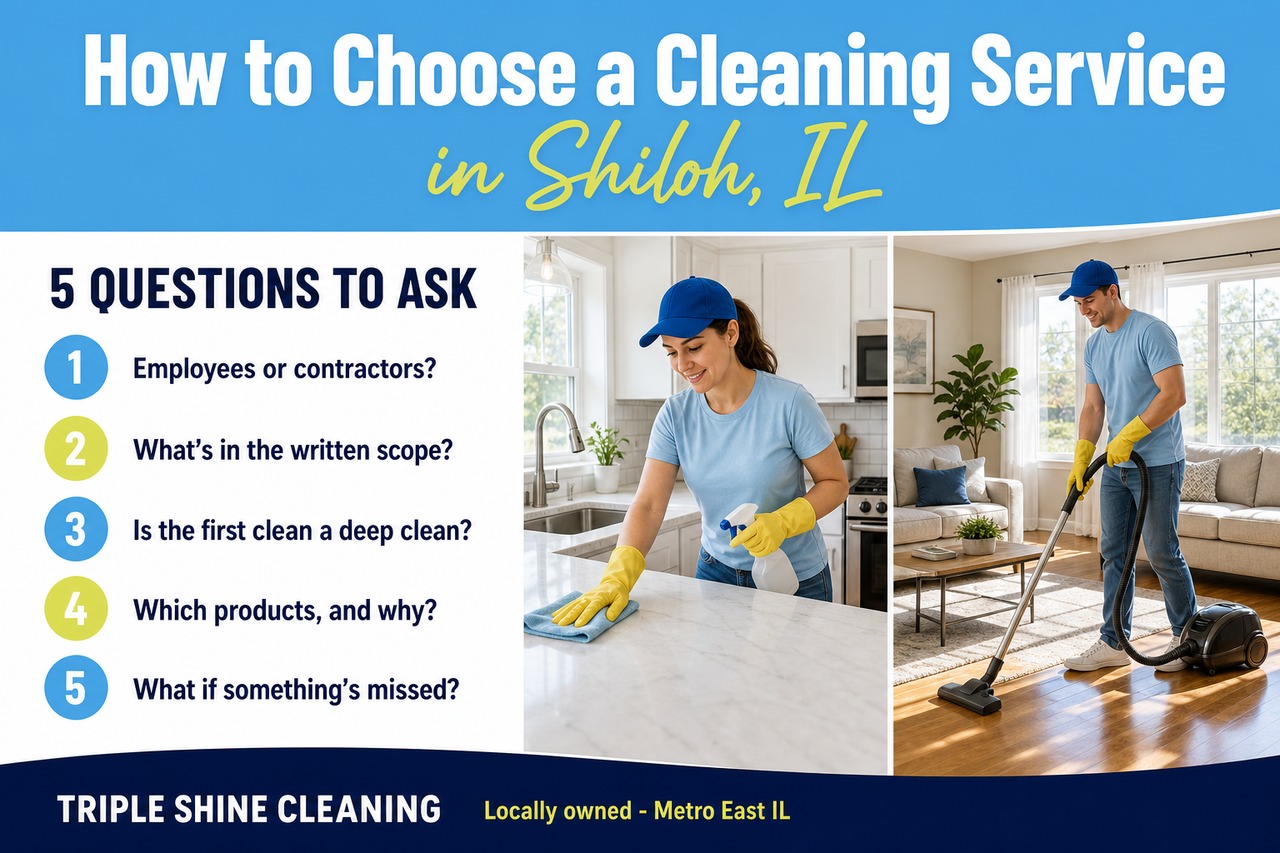
Price is the easiest thing to compare and the least useful on its own, because two quotes are rarely describing the same work. Before you compare numbers, get these five items in writing.
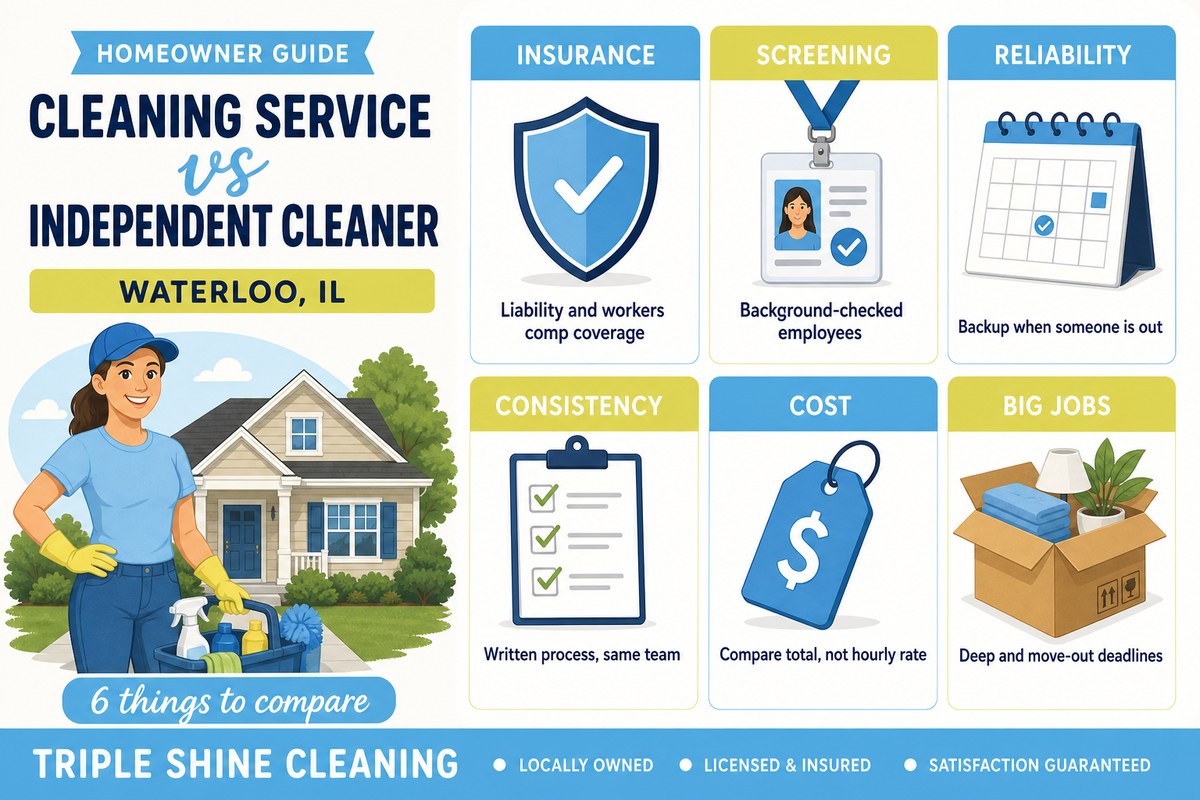
1. Employees or independent contractors?
This is the single most consequential question, and most homeowners never ask it. If a company sends independent contractors, you may get a different person each visit, and the coverage that protects you if something is damaged or someone is injured in your home can be murkier. Companies that hire, train and insure employees carry more overhead — which shows in the quote — and in exchange you get the same trained team, consistent standards, and clear accountability.
Ask directly: Are your cleaners W-2 employees? Are they background-checked? Are you licensed and insured, and can you send the certificate? Any established company answers all three in one sentence without discomfort.
2. What exactly is in scope — and what is not?
“Standard clean” means something different at every company. A written checklist should tell you whether these are included:
- Interior window and glass door cleaning
- Baseboards and door frames — every visit, or rotating
- Inside the microwave, refrigerator, or oven
- Bed linen changes
- Blinds, ceiling fans and vent grilles
- Finished basements, bonus rooms and stair carpet
- Pet-hair-heavy areas and litter or crate zones
Most companies rotate detail items rather than doing all of them weekly, which is sensible. What matters is knowing the rotation so you are not surprised in week three.
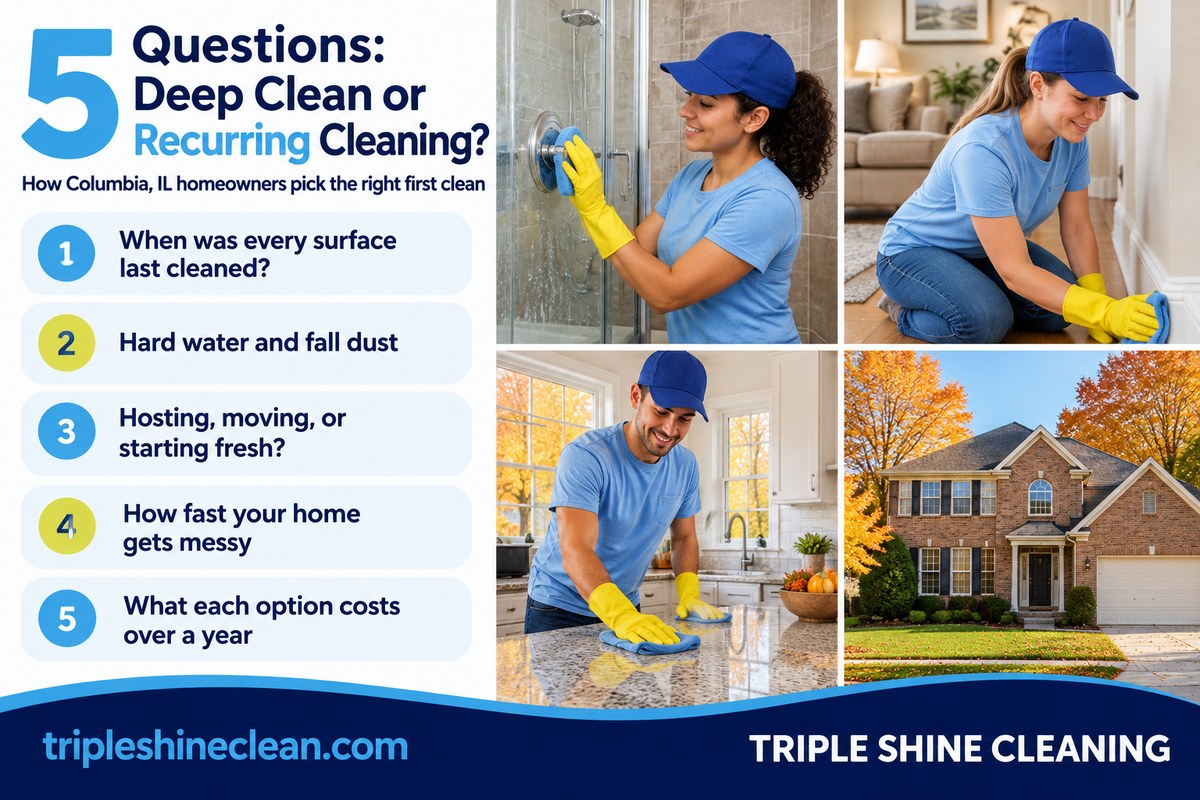
3. Is the first clean a deep clean?
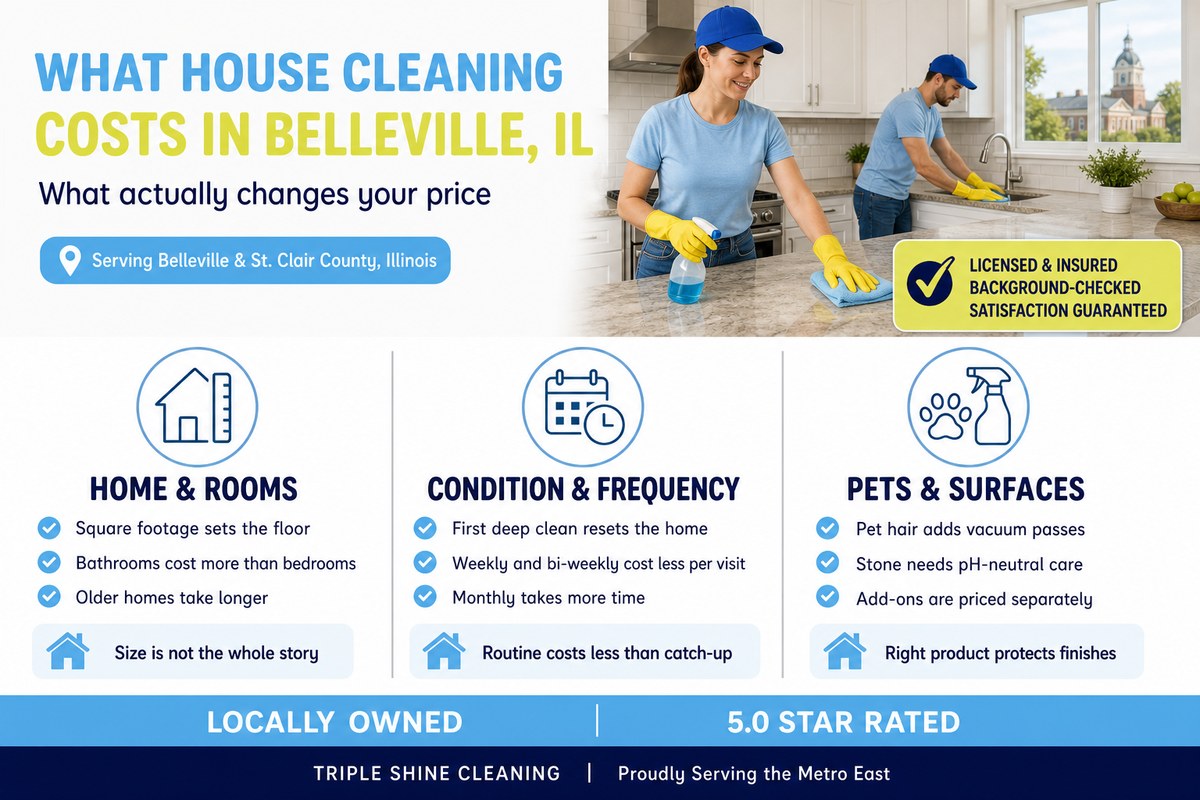
Reputable companies charge more for the first visit, and there is a real reason. A home that has not had professional attention needs soap-scum removal, grout attention, appliance detail and edge work that recurring maintenance does not require. Skipping that initial reset means the recurring visits will spend their whole time budget catching up and the home never actually gets ahead. If a quote for ongoing service shows no first-visit adjustment at all, ask how they plan to handle the backlog — the answer tells you a lot.
4. Products, and how they handle your specific home
A professional should be able to explain why they use what they use. A few examples worth listening for, because they signal real training rather than a supply-closet habit:
- Natural stone. Granite, marble and travertine should never meet acidic cleaners like vinegar or many bathroom products — the acid etches the stone permanently. Sealed stone needs a pH-neutral cleaner.
- Hardwood. Excess water is the enemy. Floors should be cleaned with a barely damp microfiber flat mop, not a sopping string mop, and never with oil soaps that build a haze on modern finishes.
- Never mix chemistries. Bleach and ammonia products must never be combined; the reaction produces toxic chloramine gas. Ask whether their team is trained on chemical separation.
- Soap scum. The white film on Shiloh-area shower glass is largely mineral deposit from hard water, so it responds to an acidic descaler and dwell time — not to more scrubbing pressure, which is what usually scratches the glass.
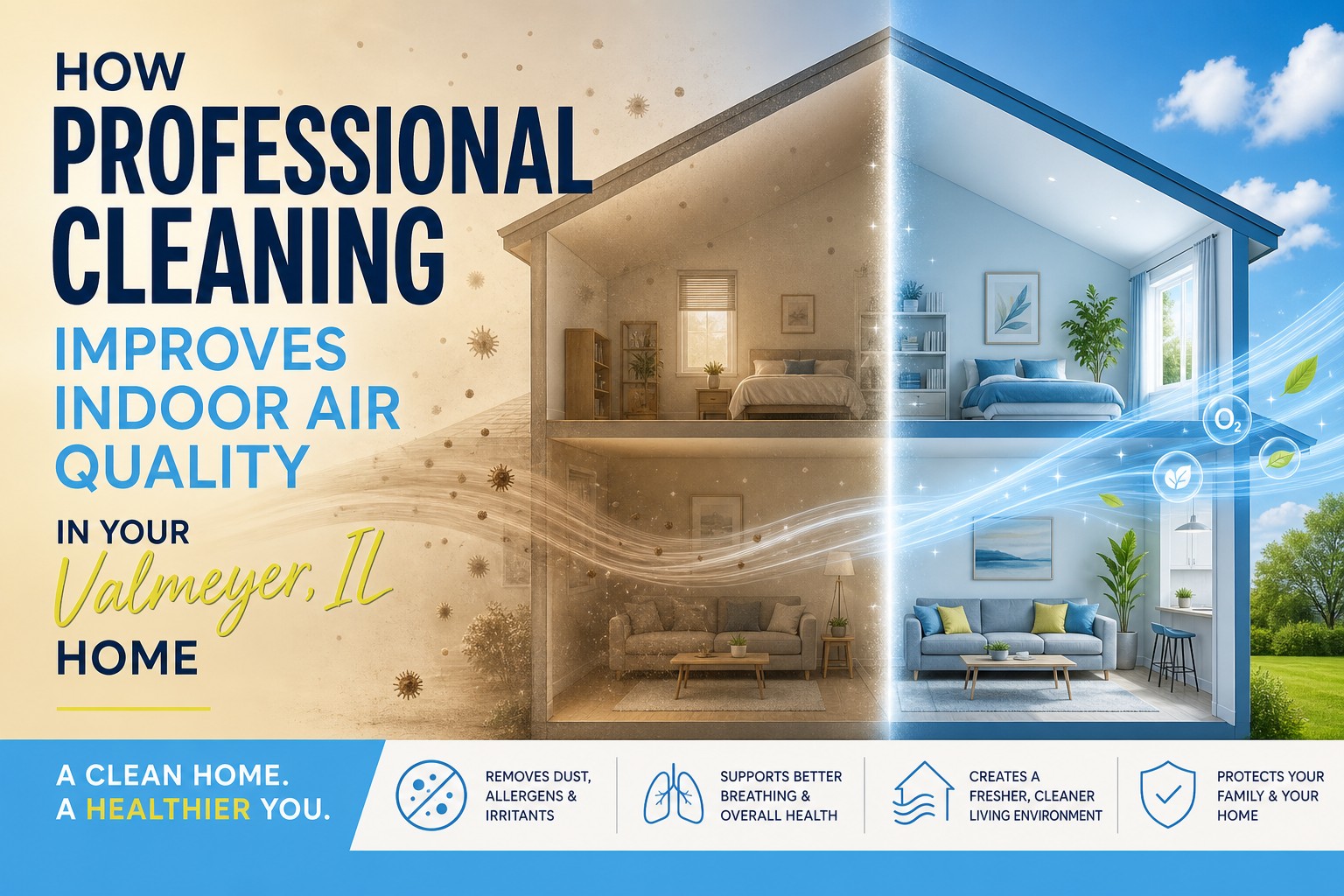
If someone in your household has asthma or allergies, ask about low-fragrance options and whether they use microfiber and HEPA-filtered vacuums, which capture fine particulate rather than redistributing it. The EPA’s indoor air quality guidance is a useful, non-commercial place to read about source control and ventilation.
5. What happens when something goes wrong?
It eventually will — a missed room, a rushed visit, a broken item. What matters is the stated policy. Ask whether there is a satisfaction guarantee, how quickly a re-clean happens, how damage is handled, and who you contact. A company willing to put a specific timeframe in writing is telling you they expect to honor it. Ours is a 100% satisfaction guarantee with a 24-hour re-clean.
Local Realities That Shape Cleaning in Shiloh
Shiloh homes have a few characteristics worth planning around, and a cleaner who knows the area should already be accounting for them.
Newer construction, finer dust. Much of Shiloh’s housing stock is relatively new, and newer homes with tight envelopes and forced-air systems circulate fine dust efficiently. That means return vents, ceiling fan blades and the tops of door casings collect more than people expect, and it also means changing HVAC filters on schedule does more for visible dust than any amount of extra wiping.
Hard water. Metro East water leaves mineral deposits on fixtures, glass and dishwasher interiors. Practical fix: keep a squeegee in the shower and use it once a day. That single habit does more than a monthly scrub, because deposits that never get a chance to dry never bond.
Seasonal tracking. Humid summers bring pollen and moisture through the door; winter brings road salt and cinders that abrade hard floors and grind into carpet. A washable mat inside and a scraper mat outside each entrance is the cheapest floor protection available.
Scott AFB schedules. A lot of Shiloh households run on rotations, TDYs and PCS timelines. If that is your reality, ask about flexible scheduling, whether they can work around an empty house with lockbox or code access, and whether the company handles both recurring service and one-time cleans — so a schedule change does not mean starting over with a new provider.
Choosing Your Frequency Honestly
Most Shiloh families land in one of four patterns:
- Weekly: households with young kids, pets, or a home that is also a workplace. Nothing ever gets far behind.
- Bi-weekly: the most common choice for a two-income household. Enough cadence to keep bathrooms and kitchens genuinely maintained.
- Monthly: works when the household keeps up with day-to-day tidying and wants the harder detail work handled.
- One-time or seasonal: deep cleans before hosting, after a move, or at the change of seasons.
Here is the honest version: if you enjoy cleaning and have the time, you can absolutely maintain your own home to a professional standard, and a once- or twice-yearly deep clean plus a move-out clean may be all you ever need from a company. Hiring recurring service makes sense when you would rather spend those hours on something else, or when the home has stopped keeping up with the household. Both are legitimate answers, and a good company will tell you so instead of pushing you into a plan.
Red Flags Worth Noticing
A few patterns reliably predict a poor experience, and they show up before the first visit:
- A firm price with no questions asked. Square footage, number of bathrooms, pets and current condition all change the labor required. A quote given without any of that information is a guess that will be revised later.
- No written scope. If nobody will send you a task list, there is nothing to hold anyone to.
- Cash-only, no invoice, no insurance certificate. That combination usually means there is no coverage standing behind the work in your home.
- Pressure to sign a long contract for a discount. Good recurring service retains clients by results, not lock-in.
- Vague answers about who enters your home. You are entitled to know whether the person holding your key is an employee and whether they were background-checked.
None of these mean a company is dishonest. They do mean you will be absorbing the risk of anything that goes wrong, and in a home with kids, pets and possessions you care about, that is a poor trade for a modest saving.
A Simple Way to Test a Company Before You Commit
Book a single deep clean before agreeing to any recurring schedule. One visit tells you everything a quote cannot: whether they arrived in the promised window, whether the crew was uniformed and identifiable, whether details like baseboard edges and shower tracks were actually addressed, and whether the walkthrough conversation at the end felt like professionals who wanted feedback. If that visit goes well, set the recurring schedule. If it does not, you have lost one cleaning instead of a season of them.
Talking to Triple Shine Clean
We are locally owned, based in Millstadt, and we serve Shiloh along with O’Fallon, Belleville, Fairview Heights, Swansea, Columbia and the surrounding St. Clair and Monroe County communities. Our cleaners are background-checked employees who work as the same trusted team, we are licensed and insured, and every visit carries our 100% satisfaction guarantee with a 24-hour re-clean. We are a Cleaning for a Reason partner and the preferred cleaning company of the Gateway Grizzlies.
If you want to see what we include before you talk to anyone, read through our residential cleaning services, take a look at our nearby O’Fallon house cleaning and Fairview Heights house cleaning pages, or check our FAQ for the practical questions about access, pets and scheduling. When you are ready for a number for your own home, request a quote — tell us your square footage, bedrooms and baths, and we will give you a straight answer.
Share this article
Related Posts



A quick overview of the topics covered in this article.